Protein Math and the Vegetarian Struggle Bus
🌼 Date: Tuesday, June 2, 2026
⚡ Energy: Low battery, but trying to fuel the repair crew
❤️🩹 Status: Realizing I am not getting enough protein
😦 Outlook: Apparently healing requires math now, which feels rude
Yesterday I talked about the exhaustion.
The kind of tired that does not politely leave after a nap.
The kind of fatigue that makes walking to the mailbox feel like an Olympic event and turns puppy potty trips into a full-body commitment.
Today, let’s talk about one of the things that might help me get some of that energy back.
Protein.
Yes, protein.
The thing every doctor, nurse, dietitian, and medical person keeps preaching at every appointment.
“Protein helps your body heal.”
“Protein helps your body recover.”
“Protein helps repair damaged cells.”
“Protein helps rebuild muscle.”
“Protein helps support your immune system.”
Trust me, I hear them.
I really do.
At this point, if one more person says “make sure you’re getting enough protein,” I may start twitching.
Not because they are wrong.
They are absolutely right.
But because knowing I need protein and actually getting enough protein are two very different things.
Especially as a vegetarian.
Cancer treatment does not just make you tired because your white blood cell count is low.
That is part of it, yes, because your immune system is trying to rebuild itself like a construction crew after a tornado.
But there is more to it than that.
Chemo and radiation do damage while they are trying to save your life.
They affect healthy cells too.
Your body has to repair tissue, rebuild strength, recover from inflammation, deal with medications, heal skin, manage stress, restore blood counts, and try to rebuild muscle that you lost while you were busy surviving treatment.
And all of that takes fuel.
Protein is one of the big building blocks your body uses for repair.
So basically, my body is over here trying to rebuild after surgery, chemo, radiation, skin reactions, inflammation, neuropathy, lymphedema, and all the other Cancerland nonsense, and I am accidentally giving the construction crew half a granola bar and good intentions.
Not ideal.
There is a math problem that is often used to estimate protein needs during cancer treatment and recovery.
A common guide is about 1.2 to 1.5 grams of protein per kilogram of body weight when your body is trying to heal and repair damaged tissues.
So let’s do the math for me.
First, you convert pounds to kilograms.
I weigh about 150 pounds.
To convert pounds to kilograms, you divide by 2.2.
150 ÷ 2.2 = about 68 kilograms
Then you multiply that by the protein range.
68 × 1.2 = about 82 grams of protein per day
68 × 1.5 = about 102 grams of protein per day
So for me, a reasonable goal is somewhere around:
82 to 102 grams of protein per day
Excuse me?
Eighty-two to one hundred and two?
Every day?
Who approved this?
Because when I started actually tracking it, I realized I am barely getting 30 to 50 grams of protein a day.
Nowhere close to what my body probably needs to heal and recover from chemo and radiation.
And suddenly the exhaustion makes a little more sense.
Not all of it.
Cancer fatigue is still its own special beast from hell.
But if my body is trying to rebuild and I am not giving it enough materials, then no wonder the repair crew is moving slowly.
Another big change since surgery is that my stomach can no longer handle anything acidic, which means I have not had regular coffee since October.
Please pause for shock and awe.
Because PC Tina needed her morning coffee.
Needed.
Not wanted.
Needed.
Morning coffee and an energy drink were basically part of my operating system when I was getting up at 4:30 in the morning and running on long workdays, stress, and pure transportation department chaos.
But now?
I am not getting up at 4:30 anymore.
I am not working ten-hour days.
I am not needing the same caffeine survival plan.
And my stomach has made it very clear that acidic coffee is no longer welcome in this establishment.
So I have been experimenting with a new morning “coffee” routine.
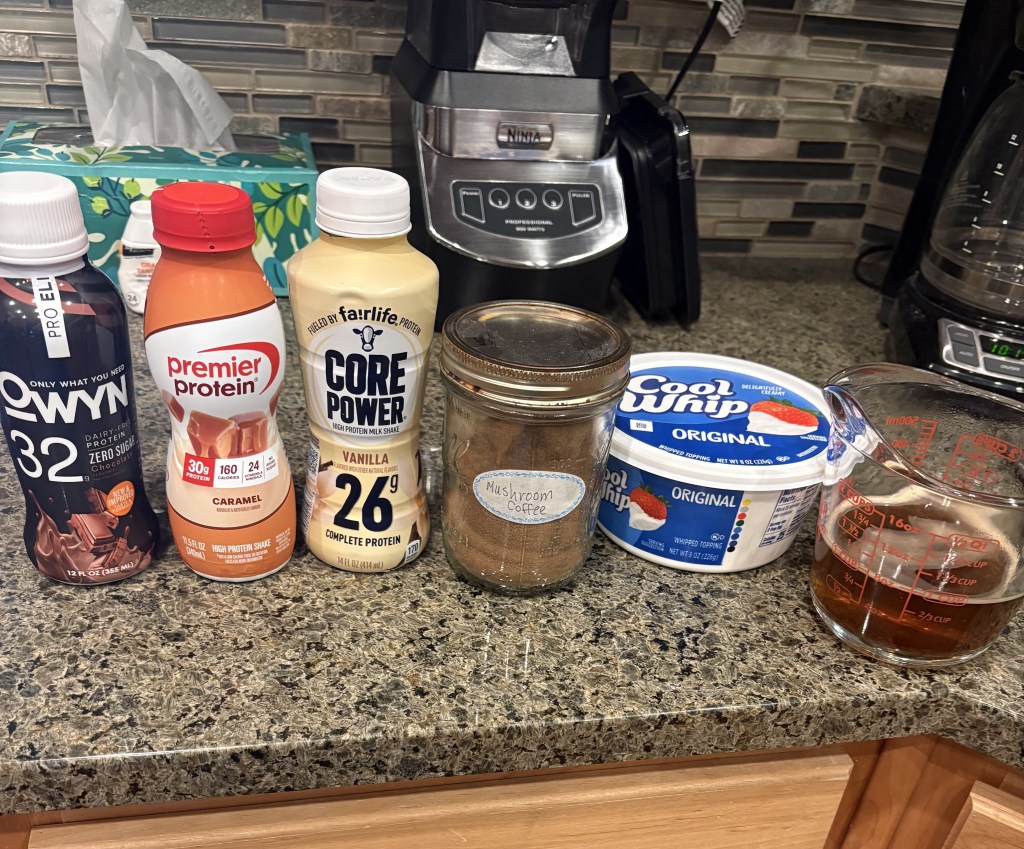
Instead of regular coffee, I have been trying mushroom coffee mixed with some variation of protein shake.
The mushroom coffee still has to dissolve in hot water first, so I mix it with hot water, then add ice to cool it down.
Then I add the protein.
My favorite combination right now is mushroom coffee mixed with the vanilla Core Power protein shake.
Sometimes I add a little caramel or chocolate protein shake too, depending on my mood and whether my taste buds are being cooperative that day.
And I always add a spoonful of Cool Whip.
Yes, Cool Whip.
Do not judge me.
It helps cut down on the chalkiness of the protein shake, and at this point, if a spoonful of Cool Whip helps me get protein into this tired little body, then Cool Whip is part of the treatment plan.
Unofficially.
Do not quote me to oncology.
It may not be my old coffee routine, but it is working for now.
And honestly, if I can sneak protein into something that feels even remotely like a morning drink, I am counting that as a win.
I have been trying.
If you looked in my fridge and pantry, you would see that almost everything I buy for myself has extra protein in it.
I am careful about what I choose.
I read labels.
I compare options.
I try to find things that are actually worth eating, not just products wearing a “protein” costume.
One little trick I use is to add a zero to the grams of protein and compare that number to the calories.
For example, if something has 10 grams of protein, I add a zero and get 100.
Then I look at the calories.
If the calories are close to or under that number, I feel like it is a pretty decent protein choice.
If the calories are way higher, then I know it might still have protein, but it may also be a calorie bomb dressed up as a high-protein snack.
This is not a perfect medical rule.
It is just a quick Tina label-check.
A tiny snack judgment system.
For example, peanut butter has about 7 grams of protein in 2 tablespoons.
Add a zero to the protein and you get 70.
But those 2 tablespoons have about 190 calories.
So yes, peanut butter is a protein-rich food, and yes, I still love it, but it is also a calorie bomb.
A delicious calorie bomb.
A useful calorie bomb sometimes.
But a calorie bomb nonetheless.
Now, because I have lost over 30 pounds on this unwanted adventure, I am not as worried about calories right now as I might have been before.
At this stage, calories are not the enemy.
Calories are fuel.
But I still want to make sure that when I am trying to get protein, I am actually getting protein, not just eating something that whispers “protein” while quietly handing me mostly sugar, fat, or disappointment.
The hard part is that when you have zero energy, the last thing you want to do is spend time in the kitchen.
Cooking sounds great in theory.
Meal prep sounds lovely.
Balanced meals sound responsible.
But when your body has one spoon and your feet are numb, suddenly standing in the kitchen chopping vegetables feels like a survival challenge.
Coming up with quick and easy vegetarian options that are still packed with protein is hard.
My goal is to get at least 30 grams of protein at each meal.
That would get me closer to the daily target without making me feel like I need to eat nonstop from sunrise to bedtime.
But actually doing that takes planning.
And energy.
And appetite.
And a stomach that is not still holding a grudge from chemo, Methotrexate, antibiotics, or whatever else I have asked it to tolerate lately.
So far, I have tried a little bit of everything.
I found Protein H2O on Amazon, which is a flavored protein water.
Because sometimes drinking protein feels easier than chewing it.
I have tried a protein broccoli soup and a berry-flavored protein drink that are both technically bariatric foods, but hey, if they have tons of protein, I am not above borrowing from another aisle of the medical nutrition world.
Protein is protein.
We are not being snobby right now.
Progresso makes protein-packed soups that are actually yummy.
I also like Clif Bars and Kind Bars for something quick to grab, even though some of them fall into that calorie-bomb category.
Again, I have lost over 30 pounds, so I am not clutching pearls over calories at the moment.
If something has protein and I can tolerate it, it is getting considered.
For meals, I am playing around with cottage cheese bowls and overnight oats bowls.
And for dinners, I have some crockpot recipes I have not tried yet, but they are in the queue.
The crockpot may become my best friend because anything that lets me throw food into a pot and walk away feels like the correct energy level for this season of life.
My favorite vegetarian “meats” are from Quorn.
Their meatless crumbles are great.
Once you put them in a pan and crumble them up, they work really well for tacos or spaghetti sauce.
They give the same kind of texture as hamburger, without the whole meat situation.
Quorn also makes my favorite chicken substitute called Chiqin Pieces, which we lovingly call not chicken.
And let me tell you, the trick with any vegetarian meat substitute is moisture and seasoning.
I cannot say that loudly enough for everyone in the back.
Moisture. And. Seasoning.
If you simply follow the package directions, you may be disappointed.
Vegetarian meat substitutes need love.
They need help.
They need flavor.
They need someone in charge who understands that “heat and eat” is not always enough.
For our favorite not chicken, no matter what dish we are using it in, it always gets the same treatment.
First, I spray the pan with vegetable oil or olive oil.
Then I add the bag of frozen Chiqin Pieces.
Then I spray the pieces with oil too.
I let them start to thaw.
Then I sprinkle all the pieces with lemon juice.
Trust me.
You can barely taste it, but it does wonders for bringing moisture to the not chicken.
Then I add sea salt, pepper, garlic powder, and onion powder.
I let the pieces brown on one side.
Then I flip each one so they can brown on the other side.
Do not skip this step.
You want those little brown edges.
That is where the texture comes from.
That is where the “okay, I can work with this” magic happens.
After that, you can add it to any dish the same way you would use regular cooked chicken.
And one cup has about 17 grams of protein.
That is a big deal when you are trying to claw your way toward 82 to 102 grams a day.
I love adding the not chicken to dishes with protein pasta and a sauce where I can add cheese.
Protein pasta adds protein.
The not chicken adds protein.
Cheese adds protein.
Suddenly dinner is doing some actual repair work instead of just showing up and looking cute.
That is the goal.
Sneak protein in wherever I can.
Build meals that actually help.
Find easy options that do not require me to spend all of my one spoon standing in the kitchen.
Because right now, I do not have energy to waste.
If I am going to cook, it needs to count.
If I am going to eat, it needs to help.
If I am going to chew through my low appetite and weird stomach issues, I want my body to get something useful out of the deal.
I am not trying to become a nutrition expert.
I am not trying to be perfect.
I am not trying to turn this into some strict food plan where I can never have fun again.
Absolutely not.
Cancer has already taken enough.
It does not get to take cheesecake.
Or tacos.
Or joy.
But I am trying to be more aware.
Because I want my strength back.
I want stamina.
I want to walk farther than the mailbox.
I want to take the puppies outside without needing a recovery period.
I want to rebuild some muscle.
I want my body to have what it needs to heal.
And if protein is part of that, then fine.
I will do the math.
I will read the labels.
I will drink the protein water.
I will eat the not chicken.
I will build the cottage cheese bowls.
I will keep experimenting until I figure out what works.
I am curious, though.
How much protein are you actually getting?
Not how much you think you are getting.
How much are you really getting?
Try tracking it for one day.
Just one day.
No judgment.
No shame.
No diet-culture nonsense.
Just information.
Add up the protein in your breakfast, lunch, dinner, snacks, drinks, whatever.
See where you land.
Because I was surprised.
I thought I was doing better than I was.
I thought because I was choosing “high protein” things, I was probably okay.
Nope.
Barely 30 to 50 grams some days.
That was eye-opening.
So maybe it is not just me.
Maybe getting enough protein is harder than people realize, especially if you are vegetarian, exhausted, nauseous, healing, or dealing with a body that seems to reject half the menu.
Or maybe my subconscious is making this harder than it needs to be.
Maybe I am overthinking it.
Maybe cancer has turned even food into another project.
Another chore.
Another thing to track.
Another thing to feel behind on.
And honestly?
That part makes me mad.
Because cancer already took over my calendar.
It took over my body.
It took over my energy.
It took over my hair, my chest, my nerves, my skin, my sleep, my stamina, and my sense of normal.
Now it wants to win the protein game too?
Nope.
Not if I can help it.
So today’s mission is protein.
Not perfection.
Not dieting.
Not restriction.
Fuel.
Repair.
Healing.
Giving this tired body the building blocks it needs to keep putting itself back together.
One protein-packed, vegetarian, carefully seasoned, hopefully easy meal at a time.
And if you have quick vegetarian protein ideas that do not require me to stand in the kitchen for forty-five minutes, please send them my way.
The repair crew is hungry.
Management is tired.
And the not chicken is doing its best.
Want to follow the journey from the beginning?
Visit Tiny Tina – Status: Alive (Daily Check-Ins) to see the full timeline of posts.
If you’d like to be notified when a new post goes live, you can subscribe below for free and get an email each time I publish a new entry.
💗 Tina –
One Badass Day at a Time

Leave a Reply